
How to fix common issues in your lawn
Northern Ireland's cool, wet climate is both a blessing and a challenge for lawns. While we rarely struggle with drought, the damp conditions make moss and yellowing grass a constant battle. This guide walks you through the most common issues - and exactly how to fix them.
General lawn maintenance
A healthy lawn is your best defence against problems. In Northern Ireland, the growing season typically runs from March through to October, so building good habits over these months makes a real difference come winter.
Mowing
Mow regularly during the growing season but never remove more than a third of the grass blade at once. Keep the height at around 4–5cm to encourage strong, deep roots.
Watering
Our rainfall usually does the work for us, but during any dry spells — even a week without significant rain — a good deep watering early in the morning helps avoid stress on the grass.
Scarifying
Rake out thatch and dead material in early autumn. This allows air, water and nutrients to reach the roots — essential in our moisture-heavy climate where thatch builds up quickly.
Aeration
Spike or hollow-tine your lawn once a year, ideally in autumn. This relieves compaction from heavy rain and foot traffic, both very common issues in Northern Ireland.
Feeding
Feed in spring and summer with a nitrogen-rich fertiliser to promote lush green growth. Switch to an autumn/winter feed that is lower in nitrogen to harden the grass before the cold arrives.
Top dressing
After aerating, top dress with a sandy compost mix to improve drainage and soil structure over time — particularly useful on our heavier clay soils. Visit our compost and bark range for suitable products.
Yellowing grass
Yellow or pale grass is one of the most common complaints, and it usually comes down to one of a handful of causes — most of which are easily fixed.
Why is my grass turning yellow?
- Nitrogen deficiency — the most common cause in Northern Ireland. Heavy rain washes nutrients out of the soil quickly, leaving the grass starved.
- Compacted or waterlogged soil — prevents roots from absorbing the nutrients that are there.
- Cutting too short — stresses the grass plants and can bleach the blades.
- Fungal disease — yellow patch and other fungal issues thrive in cool, wet conditions.
- Dog urine — creates yellow rings or patches, often with greener grass around the edges due to the nitrogen effect.
How to fix it
Start by feeding your lawn. A nitrogen-rich spring or summer lawn fertiliser will green up yellowing grass within two to three weeks in most cases. For a faster result, a soluble or liquid feed is absorbed much more quickly than granular products.
If the whole lawn looks pale rather than patchy, the soil is likely depleted — a granular lawn food applied with a spreader will give even coverage. If just certain patches are affected, a liquid feed lets you target those areas directly.
Recommended products:
- Miracle-Gro Fast Green Liquid Concentrate 1L — quick results for visibly pale lawns
- Miracle-Gro Soluble Lawn Food 1kg — dissolves in water for easy, targeted application
- Miracle-Gro Healthy Lawn 140m² — granular feed for larger lawns
Brown patches and bare areas
Brown or bare patches are frustrating, but they're very treatable. The causes differ from yellowing — brown usually means the grass is dead or dormant in that area, not just stressed.
Common causes
- Leatherjacket or chafer grub damage — these root-eating larvae are widespread across Northern Ireland and cause irregular brown patches, particularly from late summer into autumn.
- Prolonged waterlogging — kills grass roots over time in poorly drained areas.
- Drought stress — even our short dry spells can burn off grass in thin or sandy areas.
- Fungal disease — red thread and fusarium patch are both common in our damp autumns.
- Wear and tear — heavy foot traffic over the same routes compacts soil and kills grass.
- Scalping — mowing too low leaves bare, bleached patches that struggle to recover.
How to fix it
For dead or bare patches, reseeding is usually the most effective solution. Loosen the soil surface, remove any debris or dead material, and sow a good quality grass seed suited to your conditions. If the area gets little direct sun, use a shade-tolerant blend.
An all-in-one patch repair product that combines seed, feed and compost is the easiest approach — simply apply to the bare area, water in, and keep off it while it establishes. For larger bare areas, spreading fresh topsoil before seeding gives the grass the best possible start.
Best time to reseed: Spring (April–May) and early autumn (August–September) are ideal in Northern Ireland. Soil temperatures are warm enough for germination but conditions are moist — perfect for getting seed established quickly.
Recommended products:
- Miracle-Gro Patch Magic Jug 1015g — handy jug format for small patches
- Miracle-Gro Patch Magic Bag 1.5kg — larger bag for multiple repairs
- Miracle-Gro Luxury Grass Seed — premium seed for a high-quality finish
- Miracle-Gro Shady Lawn Grass Seed — for patches under trees or beside fences
- Westland Nutrient Rich Garden Soil — top dress before seeding larger bare areas

Moss
Moss is perhaps the most common lawn problem in Northern Ireland. Our high rainfall, mild winters and often shaded gardens create almost ideal conditions for it. The key is understanding that moss is a symptom — treating it without addressing the underlying cause means it will keep coming back.
Why does moss keep coming back?
- Poor drainage — wet, compacted soil is moss's preferred habitat.
- Low light — shaded areas under trees or beside fences are particularly susceptible.
- Acidic soil — common across Northern Ireland and very favourable to moss growth.
- Weak, thin grass — a sparse lawn gives moss the space to move in.
- Mowing too short — weakens the grass and leaves gaps for moss to exploit.
How to tackle it
First, apply a moss killer to treat the existing moss. You'll know it's worked when the moss turns black — this usually takes one to two weeks. Then rake it out thoroughly. This step is important: leaving dead moss creates a dense mat that blocks water and nutrients from reaching the soil.
After raking, aerate the lawn to improve drainage and overseed any thin areas to thicken the grass. Then address the root cause: improve drainage if waterlogging is the problem, apply lime if your soil is acidic, and consider whether overhanging branches can be trimmed to improve light levels.
A product that combines moss control with a lawn feed saves time and ensures the grass recovers quickly after treatment. For large gardens, a bulk treatment bag is excellent value and covers a very large area in one application.
Timing matters: Treat moss in spring or early autumn when it is actively growing. Avoid treating in very wet conditions, as products need time to work before being washed away — ideally apply when a dry spell of a few days is forecast.
Recommended products:
- Westland Moss Master Bag 400m² — dedicated moss killer for large gardens
- Westland SafeLawn 400m² — child and pet safe formula
- Miracle-Gro Complete 4-in-1 360m² — tackles moss, weeds and feeds in one application
- Miracle-Gro Compact Spreader — ensures even coverage across the whole lawn

Weeds
Dandelions, daisies, clover and plantain are the most common lawn weeds in Northern Ireland. While a completely weed-free lawn is difficult to maintain, keeping weeds under control stops them spreading and crowding out the grass.
Common lawn weeds and why they appear
-
Dandelions — deep tap roots that are hard to remove by hand; they thrive in thin lawns where they get good light to the rosette.
-
Clover — actually fixes nitrogen from the air, so it often indicates poor soil fertility. Feed your lawn regularly and clover tends to recede on its own.
-
Daisies — prefer mown, compact lawns and are a sign the grass is thin and lacks vigour.
-
Plantain — tolerates compaction and wet conditions, both of which are common here.
-
Creeping buttercup — loves waterlogged, acidic soil — very much at home in a Northern Ireland garden.
How to control weeds
A selective lawn weedkiller targets broadleaf weeds without harming the grass. Apply on a calm, dry day when weeds are actively growing — spring and early summer are best. Avoid mowing for a few days before and after treatment to allow the product to be properly absorbed through the leaves.
For lawns with multiple problems — weeds, moss and a hungry-looking lawn — an all-in-one treatment that combines weed control, moss control and lawn feed in a single application is ideal. These work particularly well when applied with a spreader for even, consistent coverage.
For individual weeds, hand weeding with a daisy grubber is often the quickest and most effective approach, especially for tap-rooted weeds like dandelions. Follow up by filling the gaps with grass seed to prevent new weeds returning.
The best weed prevention is thick grass. A dense, well-fed lawn simply leaves no room for weeds to establish. Regular feeding and overseeding thin areas is the most effective long-term strategy of all.
Recommended products:
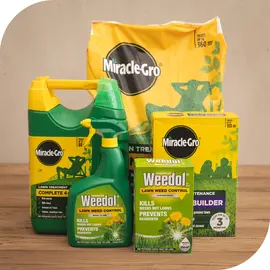
- Miracle-Gro Complete 4-in-1 360m² — tackles weeds, moss and feeds all in one go
- Miracle-Gro Lawnbuilder 200m² — weed and feed for medium to large lawns
- Miracle-Gro Compact Spreader — for even, accurate application across the whole lawn
- Miracle-Gro Patch Magic — repair the gaps left behind after removing weeds

A simple seasonal calendar for Northern Ireland
Spring (March–May)
Apply a spring/summer lawn feed as soon as growth returns. Treat moss and weeds as they become active. Overseed bare patches. Begin mowing, starting on a high setting and gradually lowering as the season progresses.
Summer (June–August)
Mow regularly and top up feeding if the lawn looks pale or tired. Repair any patches from leatherjacket or chafer grub damage. Water during any extended dry spells, ideally early in the morning.
Autumn (September–November)
Scarify to remove thatch. Aerate to relieve compaction. Apply an autumn lawn feed. Overseed thin areas while the soil is still warm. Treat moss before winter sets in. Gradually reduce mowing frequency as growth slows.
Winter (December–February)
Stay off the lawn as much as possible, particularly when the ground is frozen or waterlogged — this causes significant compaction damage. Clear fallen leaves regularly to prevent them smothering the grass. Use this time to plan your spring programme.